The simple 2 gut reactions of readers might be:
- Buuuuuh! Yeah, right!
- I knew it was a conspiracy!
We kindly and gently ask you to keep your sense and thinking open.
Quantitative data is (more) relevant (now)!
During the first months of 2020 the quantitative data (reported cases) were relevant for implementing appropriate measures to counter the spread of the virus. Remember the World Health Organization (WHO) has drafted 4 transmissions scenarios for COVID 19 (WHO – Interim Guidance issued on 22nd of March 2020) which were a mix between cases and clusters (without really defining them).
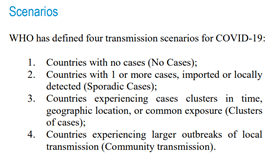
Based on those scenarios, most countries ended up in total lockdowns.
Consequently, one rule applied for everyone!
Once economic reasoning started to surface, from total lockdowns we find ourselves in various intervention loops which affect some of us. If the number, actually the cases or clusters, of COVID 19 infections rise in your community it may turn your world up side down.
As a result, quantity matters more now! It has direct consequences on policies, actions, and measures which, in practice, result in:
- permission to enter or exist a country
- affecting the family budget – you need to pay for tests if you need to travel to a country or area for work or holiday,
- possibility to work – one cannot work if he or she has to stay in isolation for X number of days after travelling to one country for vacation or business
- unemployment – if the area where you live is in quarantine and your workplace is somewhere else, you do not get paid or even lose the job
- budget allocation for a country from EU or the Federal Government in US
So, from one rule for all we have more rules for some!
Isn’t that a recipe for social inequality even only at perception level and isn’t this a recipe for social disorder?
We have shown quantity, a number, matters greatly both for individuals and countries. Therefore, we should treat data (number) collection with gigantic attention!
Well, are we?
Another example
To get away from the heat of the action and hopefully use more reasoning, to answer this question we propose you take the time and study a scenario for a completely different problem.
Say you want to know how many new cars are rubbing against the fresh laid down asphalt in your country.
Where do you get your data?
| The (possible) solution | The critics | |
| 1. | I would ask all the car manufactures how many new cars they sold in my country | If the cars are still at the car dealer’s shop, they are not rubbing against the asphalt! |
| 2. | I would ask the car dealers in my country how many new cars they have sold | If I bought a car from another country, you would not count me in! |
| 3. | I would ask the office for car registration how many new cars have been registered | If I am living in another country and came to your country for holidays I would not be in that statistics! |
| 4. | I would install pressure sensors on all the roads and find out how many cars are passing by | If I drive 3 times in the same street you would count 3 cars so you will not have the exact number of cars! |
| 5. | I would also install license plate recognition cameras and software and I will remove all the duplicates | If I change the license plate number on my car you would count 2 cars and your answer will not be accurate |
| 6. | I will ask other countries how they do it (what is the methodology) or I will search the internet for solutions | Some will answer but they will not match 100% the administrative business flows in your country |
| 7. | I am fed up with people who always say it is not possible! | I am a business analyst, ask a statistician![1] |
[1] More on differences here: https://www.northeastern.edu/graduate/blog/data-analyst-vs-business-analyst/
It seemed the question was clear and the answer not particularly hard to get.
By instinct and experience alone anyone could say if there are more or less cars but putting our finger on one exact number (not cases or clusters) … not so easy.
And numbers matter! Greatly!
Stop and smell the roses
One fallacy of performance evaluation states that a manager tends to be influenced by the latest work of an employee and overlooks some old achievements or mistakes which still occurred during the same assessment period.
What if humanity is caught up in the latest achievements and overlooks the entire business process?
Are we so into artificial intelligence, quantum computing, predictions, machine learning, deep learning, generating models, patterns, trends, forecasting, heat maps, bubble maps, and dashboards that we do not care about the source of data?
Why do we overlook the origin of data?
Here are some plausible answers:
- Countries must do their best, taking into consideration the pandemic so their numbers are correct
- It is easy to report how many COVID 19 cases are in one country, there has to be a system in place
- It must be a worldwide methodology on how and what to report
- Everyone has the same definition of COVID 19 reporting terms like: “cases”, “new cases”, “clusters”, “death related to COVID 19”, etc.
- Data is coming in constant flows so, clearly, there is a mechanism in place
- There are (almost) no signs that data is wrong so why question
Patient zero: data (numbers)
No methodology!
No IT systems or apps!
No database models!
Exactly! There is no public data on:
- Methodologies or procedures about how to count and report COVID 19 numbers, individuals, cases or clusters!
- IT systems existing or presented as best practice (or even implemented or tested) to assist COVID 19 case reporting! So, Mr. Jobs “there is NO app for that”!
- Data models (the ways information is organized in an application / a software programme) about how it might be better to design, develop and manage the workflows, stakeholders and so on in electronic environment did not surfaced!
Yet, we have dashboards and maps and charts!
Yet, we use all these to describe, interpret, evaluate, analyze, predict, and estimate!
Yet, (finally) we package everything as bedrocks for our measures and actions, thus justifying (all) the consequences!
Where do numbers come from and what do they really mean?
Cases not numbers! Touche!
Nice and elegant touch! Sadly, it brings up (again) more questions than answers.
Why use cases instead of number of persons which are infected with COVID 19?
Does this mean that we can experience scenarios when “a person = more cases” OR “more cases = one person”?
If “persons ≠ cases” it means that when you set a quarantine in a neighborhood because of increase in cases you cannot touch, literally, put your finger on ALL the cases because they are not equal to persons.
We might depict what is the definition of a case if we use interpretative analysis (which humans are good at these times) on chart below:
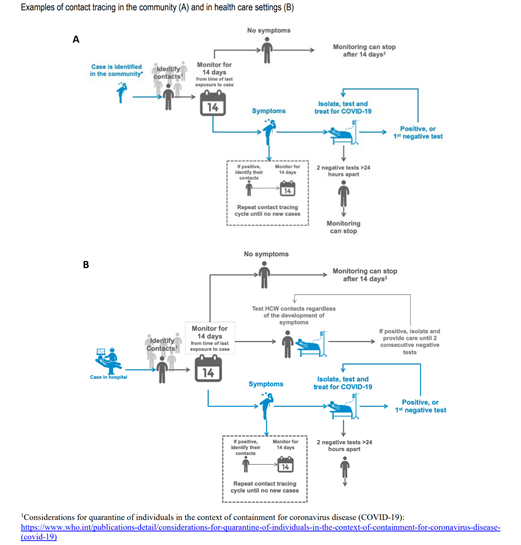
The chart can be found at page 3 of this document:

1 = 1 or 1 = more?
There is our answer! The word “case” is written in blue:
- example A “case is identified in the community”
- example B “case in hospital”
Mystery solved!
If we show the chart to a business analyst, he or she will come up with the following:
- Aha! The case is a process
- I can report a process as 1 (clearly it has a beginning and an end) so 1 = 1
- I can report each stage of the process, so 1 = 4
- I can report the stages and the iterations of the process (since step 4 happens with every repeating test), so 1 > 4
This is how the chart will be amended:
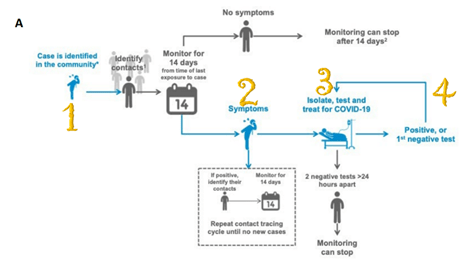
And with so many possible answers (just like in the car and asphalt example), the world wide dashboards simply display one number! Ups, we apologize, they show a number of cases!
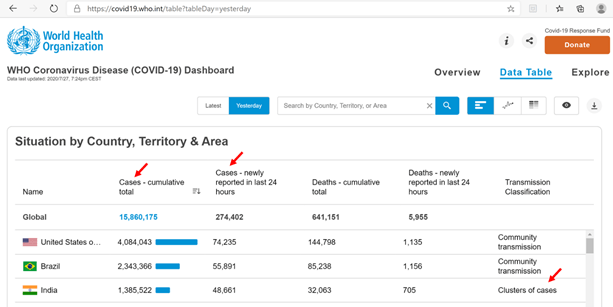
And the rest will just follow the same line:
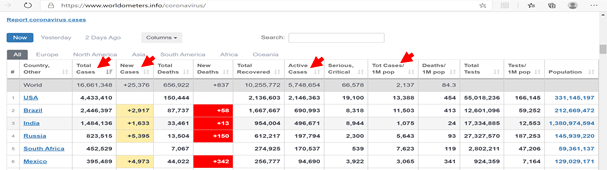
One last thing, what are “cases – newly reported” (shown in the table of WHO) or “new cases” (shown in the second table of worldometers)?
It could be a new case in stage 1, it also might be the positive result of a retesting performed during the iterative process (stage 4). It is an important distinction to know if “new cases” represent:
- X number of persons which have been infected in the last 24 hours
- OR
- X number of persons who have the virus in the last 24 hours even though they were infected 2 days before
- OR
- X number of persons who have tested positive in the last 24 hours maybe for the first time or +1 time
Wishful thinking
- The norms or the methods used for collecting data about COVID 19 should exist in all countries
- They should also be transparent, readable and understandable: simple charts, logic representations
- With all the IT&C savvies in the world and with unlimited capacity for crowd sourcing we should design, develop and publish a data model, an open source code, an app which might assist data collection throughout a transparent process from bottom (individual) to the top (Governments r WHO)
- The need to understand data using critical thinking should be as important for individuals, media and influencers as presenting trends and predictions
- A molecular part of the enormous budgets showcased in USA or EU to fight the impact of COVID 19 should finance the understanding of the reporting process
 sensenthink